How to Become a Travel Advisor Without Joining an Agency in 2026
How to Become a Travel Advisor Without Joining an Agency in 2026
For a lot of people, becoming a travel advisor sounds like something you have to do through a travel agency.
You imagine an office, a manager, booking systems, supplier contracts and years of industry experience.
But that’s not the only way anymore.
In 2026, you can build a travel-advisory business around your own knowledge, your own audience and your own niche. The important thing is understanding what kind of travel advisor you actually want to become.
If you only want to help people plan trips, recommend hotels, create itineraries and share destination knowledge, you can start fairly simply.
If you want to sell and ticket travel on behalf of clients, that’s a different business and may involve registrations, accreditation, supplier agreements and local legal requirements. IATA itself notes that accreditation requirements vary by country.
So before buying a fancy website or printing business cards, decide what service you actually want to provide.
What Does a Travel Advisor Do?
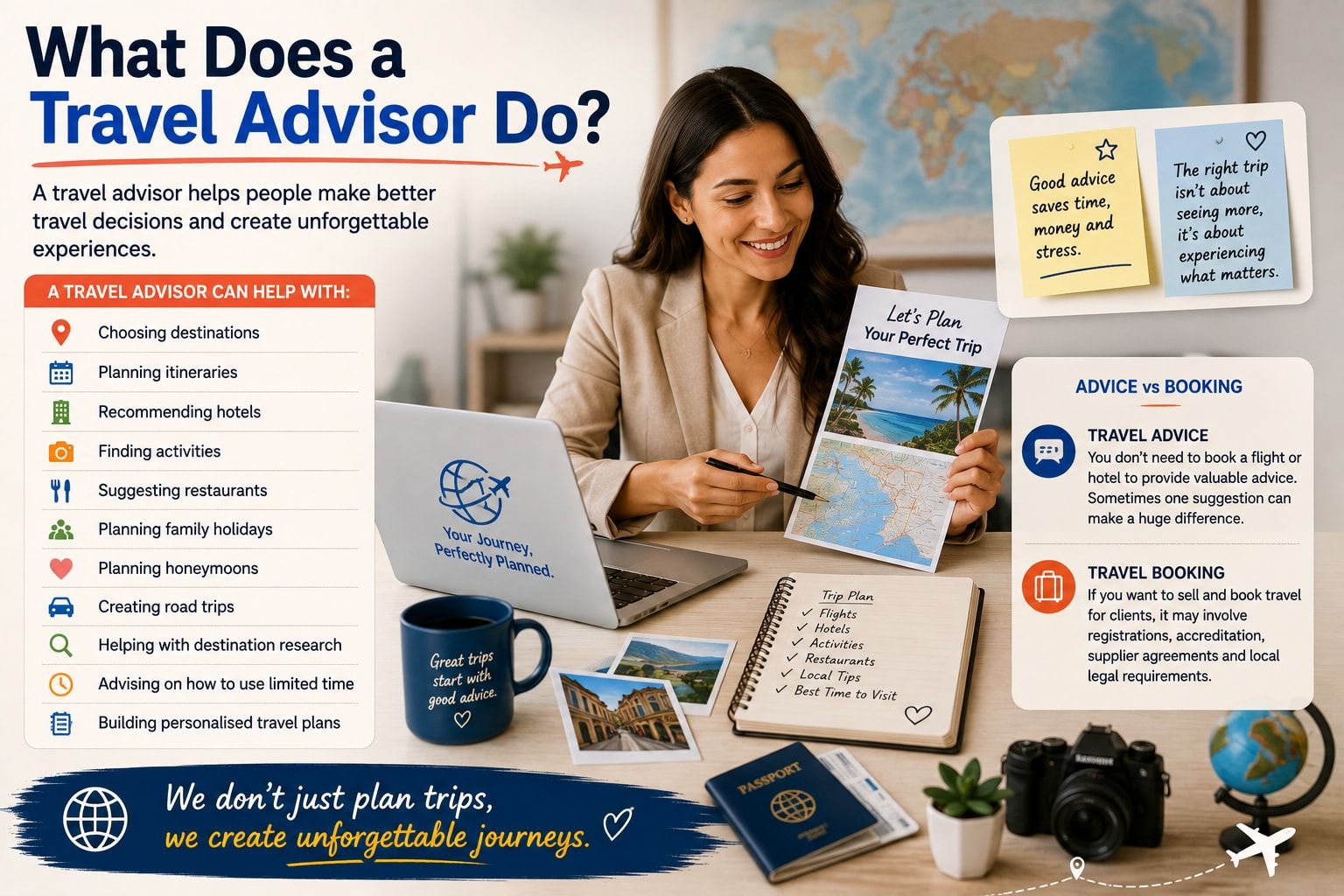
A travel advisor helps someone make better travel decisions.
That can include:
- Choosing destinations* Planning itineraries
- Recommending hotels* Finding activities
- Suggesting restaurants* Planning family holidays
- Planning honeymoons* Creating road trips
- Helping with destination research* Advising on how to use limited time
- Building personalised travel plans
And there is an important difference between travel advice and travel booking.
You don’t necessarily have to book a flight or hotel to provide useful travel advice.
Someone may simply need an experienced person to look at their five-day Italy trip and say:
“You’re trying to visit four cities. Don’t. Pick two.”
That advice can be more valuable than another generic travel blog.
Can You Really Start Without a Travel Agency?
Yes, but there is a catch.
There are actually two different paths people often mix together.
Path 1: Independent Travel Advisor
You operate your own travel business and potentially arrange or sell travel products for clients.
This can involve business registration, supplier relationships, insurance, payment systems and industry accreditation depending on where you operate and what you sell.
IATA offers accreditation programs for travel agencies, and its requirements differ by country.
Path 2: Travel Planner / Travel Consultant
You sell your knowledge and planning expertise.
You might create:
- Custom itineraries* Destination guides
- Travel consultations* Trip-planning sessions
- Personal recommendations
The traveler handles their own bookings.
This second model is much easier for someone starting from scratch, especially if you’re a travel creator, blogger or someone with strong destination knowledge.
Step 1: Pick a Travel Niche
Don’t start by saying:
“I can plan any trip anywhere in the world.”
That’s difficult to market.
Instead, become known for something specific.
For example:
- Japan travel* Luxury Europe
- Budget Southeast Asia* Family travel
- Solo travel* Honeymoons
- Adventure travel* Dubai travel
- Indian family holidays* Road trips
- Weekend trips from a particular city
If someone sees your profile and immediately knows what you’re good at, you’re already ahead.
A simple example
Instead of:
I help people plan their holidays.
Try:
I help first-time travelers plan stress-free Japan trips.
The second one is much easier to understand.
Step 2: Start With Places You Actually Know
You don’t need to know every destination.
Start with somewhere you’ve personally travelled to or researched deeply.
Your own experience gives you useful details that generic travel websites don’t always have.
For example:
- Which neighbourhood is convenient* Which tourist attraction isn’t worth the queue
- How long transportation actually takes* Where you made mistakes
- Which hotel location worked well* What you would do differently next time
Those details are your advantage.
Step 3: Turn Your Knowledge Into a Service
This is where your hobby starts becoming a business.
You could offer something simple like:
30-Minute Travel Consultation
The traveler tells you:
- Destination* Dates
- Budget* Number of people
- Interests
You spend 30 minutes helping them make decisions.
Or you can offer:
Custom 7-Day Itinerary
You create a personalised day-by-day plan based on their needs.
You don’t need 20 different services.
Start with one or two.
Step 4: Build Proof Before Charging Too Much
If you’re completely new, don’t immediately position yourself as a $500-per-trip expert.
Start by helping a few people.
Ask them:
- Was the plan useful?* What part saved you the most time?
- What was confusing?* What would you change?
Then ask for permission to use their feedback as testimonials.
Your first few clients are not just income.
They’re also proof that your service works.
Step 5: Build a Simple Online Presence
You don’t need an expensive website on day one.
A simple profile can include:
Who I help
Destinations I specialise in
What I offer
Example itineraries
Client testimonials
How to contact me
Instagram, TikTok, YouTube, LinkedIn or a simple personal website can all work.
If you’re already a travel creator, you’re in an even better position because you’ve already built an audience.
Step 6: Use Your Existing Travel Content
This is something many creators overlook.
You may already have hundreds of pieces of travel content.
A Reel about:
“5 places to visit in Paris”
can become a useful Paris guide.
A YouTube video about your Japan trip can become a day-by-day itinerary.
An Instagram carousel about Bali hotels can become a proper accommodation guide.
Instead of creating everything again, organise what you already know.
Platforms like Turom are built around this creator-to-travel-advisor idea. Its creator platform lets people turn travel content into guides and offer personalised travel consultations.
Step 7: Don’t Confuse Followers With Customers
You don’t need millions of followers.
Imagine you have 5,000 followers.
If 100 of them regularly save your travel recommendations and 10 are planning a trip every month, that’s potentially more useful than having 100,000 followers who never travel to your specialty destinations.
Travel advice is a trust business.
Someone needs to believe that your recommendation will actually make their trip better.
So focus on useful content, not just follower numbers.
Step 8: Decide How You Will Make Money
There are several options.
Paid Consultations
Charge for your time and expertise.
Custom Itineraries
Create personalised trip plans.
Digital Travel Guides
Create a guide once and sell it multiple times.
Affiliate Income
Recommend hotels, tours, travel products or experiences through legitimate affiliate programs where appropriate.
Creator Partnerships
Work with tourism boards, hotels and travel brands.
You don’t have to choose only one.
Over time, you can build several income streams around the same expertise.
Step 9: Keep Your Advice Current
This is very important.
Travel information changes constantly.
A restaurant closes.
A museum changes its hours.
A hotel changes its policies.
A visa rule changes.
A train route changes.
So don’t assume a guide you wrote three years ago is still completely accurate.
Before selling an older itinerary, quickly check the important information.
Your reputation is worth more than one sale.
Step 10: Know When You Need Professional Travel Credentials
This is the part people sometimes skip.
If you’re simply selling travel planning, recommendations or consultations, your requirements may be different from someone who is actually selling travel products.
But if you’re planning to operate as a traditional travel agency, issue tickets, take payments for bookings or represent suppliers, check the rules where your business operates.
For example, IATA provides formal accreditation programs and country-specific requirements for travel agencies.
Don’t assume that because someone on social media calls themselves a “travel advisor,” they automatically have the right credentials to sell every type of travel product.
What About Starting Without Any Travel Experience?
You can start learning, but don’t pretend to have expertise you don’t have.
If you’ve only visited one country, that’s okay.
Become really good at that country first.
Research:
- Transportation* Areas to stay
- Typical trip lengths* Seasonal differences
- Common tourist mistakes* Family-friendly options
- Budget options* Luxury options
- Local experiences
Then slowly expand.
Being honest about your expertise is much better than trying to look like a travel expert overnight.
How Turom Can Help New Travel Advisors
This is where the creator model becomes interesting.
You don’t necessarily have to start by building a complicated travel-planning business from scratch.
With Turom, travel creators can create travel guides from their existing knowledge and offer one-on-one travel consultations. Turom’s creator platform is designed to help creators turn their travel content and expertise into paid products.
For example, if you’ve travelled extensively around Bali, you could create:
Bali: 7-Day First-Time Traveler Guide
Then offer:
30-Minute Personalised Bali Planning Consultation
Your audience can get your actual recommendations instead of another generic AI-generated list.
Turom also says creators retain ownership of their content and can use the platform without a monthly fee, with a commission on sales.
Want to turn your travel knowledge into a real service? Explore Turom for creators.
A Simple 30-Day Starting Plan
If you’re serious about trying this, don’t overcomplicate it.
Week 1
Choose your niche and destination.
Week 2
Create one useful travel guide and one consultation service.
Week 3
Publish useful content around your destination and share your expertise.
Week 4
Start taking your first enquiries and improve your service based on feedback.
That’s enough to get started.
You don’t need a logo, office, expensive camera or 50-page business plan before your first customer.
Start small.
Learn what people actually want.
Then build from there.
Frequently Asked Questions
Can I become a travel advisor without working for a travel agency?
Yes. You can build an independent travel-planning or consulting business. However, if you want to sell or book travel products on behalf of clients, licensing, accreditation and other requirements may apply depending on your location and business model.
Do I need a degree to become a travel advisor?
Not necessarily. There isn’t one universal degree requirement for becoming a travel advisor. What matters is your destination knowledge, customer service, planning ability and understanding of the travel industry.
Do I need IATA accreditation?
Not for every type of travel-planning business. IATA accreditation is relevant to travel agencies and specific agency activities. Requirements depend on your business model and country.
Can I become a travel advisor from home?
Yes. An independent travel business can be operated remotely, although the legal and accreditation requirements depend on what you’re selling and where you’re based.
How can a beginner get their first travel clients?
Start with people who already know and trust you. Share useful destination content, offer a simple service and ask early customers for testimonials and referrals.
Can travel creators become travel advisors?
Absolutely. In fact, creators already have something traditional advisors spend years building — an audience that trusts their recommendations.
Can I sell travel guides instead of booking trips?
Yes. Selling destination guides, personalised itineraries and consultations is one way to monetise travel expertise without necessarily becoming a traditional booking agency. Turom specifically supports guides and paid consultations for travel creators.
Is being a travel advisor a good side business?
It can be, especially if you already have destination knowledge or a travel audience. Start with a small number of services rather than trying to become a full-service travel agency immediately.
Final Thoughts
Becoming a travel advisor in 2026 doesn’t have to mean walking into a travel agency and asking for a job.
You can start with something much smaller.
One destination. One skill. One useful service.
Maybe you’re the person who knows Japan inside out.
Maybe you’ve spent years travelling through Europe.
Maybe you know how to plan affordable family trips better than anyone you know.
That knowledge has value.
The real opportunity is to stop thinking of your travel experience as something you only share for likes and start treating it as something you can package, improve and sell.